

Paul Klee famously wrote that “a line is just a dot that went for a walk, freely and without a goal.” Applied to a Neurographic© line, this walk might unfold in nature: floating down a river, scaling a mountain, or strolling along the seashore. Rather than moving predictably, the line responds moment by moment, guided by attention rather than habit.
What are Neurographic© lines?
Neurographic© lines follow a natural, organic path with continuous twists and turns. They are defined by two key characteristics:
- The line does not resemble itself at any point in its movement, meaning there are no repeating patterns.
- The line is intentionally guided into unexpected directions.
As we draw, we consciously change direction whenever the line begins to feel familiar, repetitive, or predictable, such as forming waves or moving toward a known destination. This deliberate interruption of habit is central to the process.
How does this differ from doodling?
Doodling is usually an absent-minded activity that happens spontaneously while listening or thinking about something else. It often involves small images, symbols, or repetitive lines, and can feel calming or meditative.
Neurographic© lines, by contrast, are drawn with focused attention and intention. They typically form part of a structured drawing process that includes abstract shapes and specific techniques aimed at releasing limiting beliefs, exploring challenges, or working toward clarity. This method is known as Neurographica©.*
Neither doodling nor Neurographica© requires artistic skill. Anyone who can draw basic lines and shapes can engage in both. However, Neurographica© goes deeper. It is a coaching, and self-coaching, method that works with the internal tension, or resistance, that can arise while drawing. Through this process, new neural pathways are formed, and access to the subconscious is encouraged. As we draw, we reflect on emotions, body sensations, and the evolving image, allowing insight and clarity to emerge.
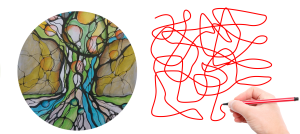

Try this simple exercise: Doodling vs. Neurographica©
Try this short exercise to experience the difference for yourself.
Step 1: Doodling
- Set a timer for two minutes.
- While thinking about your day, casually doodle on a piece of paper.
- Let your hand move freely without paying much attention.
- Notice the shapes, patterns, or symbols that appear.
Step 2: Neurographic© Lines
- On a new sheet of paper, draw a rectangle about the size of a postcard.
- Take a moment to choose a simple intention or issue, such as gaining clarity around a decision or releasing tension.
- Set a timer for two minutes. Write down any words that are related to your intention on the back of the page, or around the rectangle. Select the words that stand out to you as more meaningful or surprising.
- Draw a Neurographic© line inside the rectangle, going from one edge to another. If the line starts to feel too predictable, change direction.
- Add more lines inside the rectangle. Lines can go side to side, or top to bottom.
- Pay attention to any thoughts, feelings, or sensations while you draw.
- Look at the places where the lines cross. Round off sharp corners with small U-shaped curves to make the drawing feel smoother.
- Notice how your feelings, body, or insights may change as you finish.
Step 3: Reflect
Compare the two drawings. Notice differences in focus, awareness, and internal experience. Doodling may feel relaxing, while the Neurographic© line often brings deeper engagement and insight.
Whether you choose doodling or Neurographica©, stepping beyond the line invites awareness and movement. Each mark on the page creates an opportunity for reflection, release, and change. While the depth of impact may differ, engaging with drawing as a conscious practice has the potential to shift perspective and open new possibilities in everyday life.
Written by: Carike Draper, Neurographica© Specialist.
*Neurographica© was developed by Prof. Pavel Piskarev in 2014.
Disclaimer: The exercise outlined above is not a full Neurographica© session and is intended only to demonstrate the basic drawing skills used in this method. Individual experiences may vary, and immediate outcomes are not guaranteed. Meaningful results depend on each client’s commitment to taking aligned action.
Instagram: https://www.instagram.com/firesoul_coaching/
